Ask GRAI Anything
Your Real Estate Questions, Answered Instantly via Chat

Help us make GRAI even better by sharing your feature requests.

A real estate agent’s job has always involved more than finding properties. The best agents help clients understand what a property really means.
For investor clients, that expectation is rising quickly.
A buyer no longer sends a listing and asks only whether the location is good or whether the price looks reasonable. They ask whether the rent is achievable, whether the DSCR works, whether the assumptions are too optimistic, whether insurance could hurt the cash flow, whether the refinance is realistic, whether an off-plan exit is liquid, whether a short-term rental can legally operate, or whether the deal still works if the base case breaks.
That is a very different conversation from forwarding a listing link.
This is why GRAI is launching Branded Deal Reports, a new AI real estate deal report product built for agents, brokers, and investor-facing professionals who need to turn a property opportunity into a client-ready investment memo.
A branded deal report is not a listing page. It is not a spreadsheet screenshot. It is not a generic AI response pasted into an email. It is a structured, branded report that helps answer the real client question: should this property be pursued, negotiated, passed on, or verified further?
The report carries the preparing agent’s brand, but its real value is the decision support behind the brand.
Investor clients can find listings by themselves. They can search portals, ask AI tools, compare neighborhoods online, and run simple calculations. What they cannot always do is turn a property into a structured decision.
That is where agents can create a stronger client relationship.
In practice, most investor-facing agents already use a mix of tools. They rely on local knowledge, listing links, spreadsheets, calculators, lender feedback, broker commentary, transaction comps, analyst support, and sometimes generic AI tools. All of these can be useful. The gap appears when the client needs something fast, branded, structured, and decision-ready.
A spreadsheet may be flexible, but it takes time and is rarely client-friendly without additional explanation. A calculator may produce useful metrics, but the agent still has to explain the assumptions, the risks, and the next step. A generic AI chat can discuss the deal, but the result may not follow a consistent underwriting method or produce a polished report an agent would confidently send to a serious investor.
GRAI Branded Deal Reports are designed for that missing middle. They help agents move from informal opinion to a presentable investment memo, without turning every early-stage property review into a manual underwriting exercise.
A branded deal report is a client-ready real estate investment memo prepared under the agent’s brand. It evaluates a property based on the specific objective being considered, whether that is rental income, short-term rental performance, BRRRR feasibility, fix-and-flip potential, commercial cash flow, development upside, buy-versus-rent logic, or a listing strategy.
The best branded deal reports do not simply make a property look attractive. They explain what is known, what is assumed, what is missing, and what still needs to be verified.
A strong report should include a clear verdict, underwriting logic, scenario analysis, risk flags, assumptions, source notes, and a confidence score. It should be able to say that a property looks promising. It should also be able to say that the deal is tight, that the rent needs verification, that the NOI does not reconcile, or that the evidence is not strong enough to support an aggressive offer.
That restraint is what makes the report useful.
GRAI Branded Deal Reports are now available for agents and investor-facing real estate professionals.
The workflow starts with a free property preview, which gives users an early read before committing to a full report. If the opportunity is worth deeper analysis, users can generate the full branded report for a flat $49 per property, with no subscription required.
The product is built around an adaptive intake form. Instead of asking every user the same generic questions, the intake changes based on the property type and objective. A short-term rental deal needs different inputs from a BRRRR deal. A commercial income property needs different evidence from a buy-versus-rent decision. Development land needs a different feasibility lens from a stabilized rental.
That is why the intake is central to the product. Good deal analysis does not begin with the PDF. It begins with asking the right questions.
Many weak investment analyses fail before the math starts. The problem is not only a bad formula. It is that the wrong inputs were collected.
For a long-term rental, the report needs to understand rent, vacancy, financing, taxes, insurance, maintenance, management, and reserves. For a short-term rental, nightly rate, occupancy, seasonality, cleaning, platform fees, management, permit status, and local restrictions become much more important. For a BRRRR, the key questions shift to rehab budget, after-repair value, refinance assumptions, rent after stabilization, holding period, and exit risk.
Commercial income properties require another level of information. The report may need rent roll, lease structure, tenant quality, NOI, rollover risk, expense recovery, capex exposure, and whether the submitted income matches the evidence. Development land requires zoning, infrastructure, entitlement path, construction cost, absorption, timing, and exit value.
A generic intake can miss these differences. GRAI’s adaptive intake is designed to match the analysis to the actual deal objective.
That is what allows one product to support multiple property types and strategies without reducing every opportunity to the same rental calculator.
GRAI Branded Deal Reports are built for a wide range of investor-facing conversations. The same product can support long-term rental analysis, mid-term rental analysis, short-term rental analysis, BRRRR strategy, fix-and-flip analysis, commercial income properties, development land, buy-versus-rent decisions, and listing pitch reports.
This is important because real estate agents rarely deal with only one type of client question. One investor may ask about a rental. Another may ask about an STR. A seller may need a listing pitch. A developer may want to evaluate land. A buyer may want to understand whether buying makes more sense than renting. A commercial client may care about lease risk rather than bedroom count.
A useful AI real estate deal report product should adapt to these different objectives instead of forcing every deal into one template.
Also Read: Seller Psychology vs Buyer Psychology
The final output is a branded PDF that the agent can send to a client, use in a consultation, attach to a follow-up, discuss with a lender, or use as part of an investor onboarding process.
The report includes a plain-language verdict, the key underwriting numbers, scenario analysis, risk flags, evidence notes, assumptions, confidence score, and a client conversation frame. The goal is not to overwhelm the client with a spreadsheet. The goal is to make the property easier to judge.
For agents, this changes the tone of the relationship. Instead of saying, “Here is the listing, let me know what you think,” the agent can say, “Here is the deal memo, here is where the numbers work, here is where they do not, and here is what we should verify before we move.”
That is a different level of service.
Use GRAI to turn your next investor listing into a branded, decision-ready memo - not just a forwarded link: https://internationalreal.estate/chat
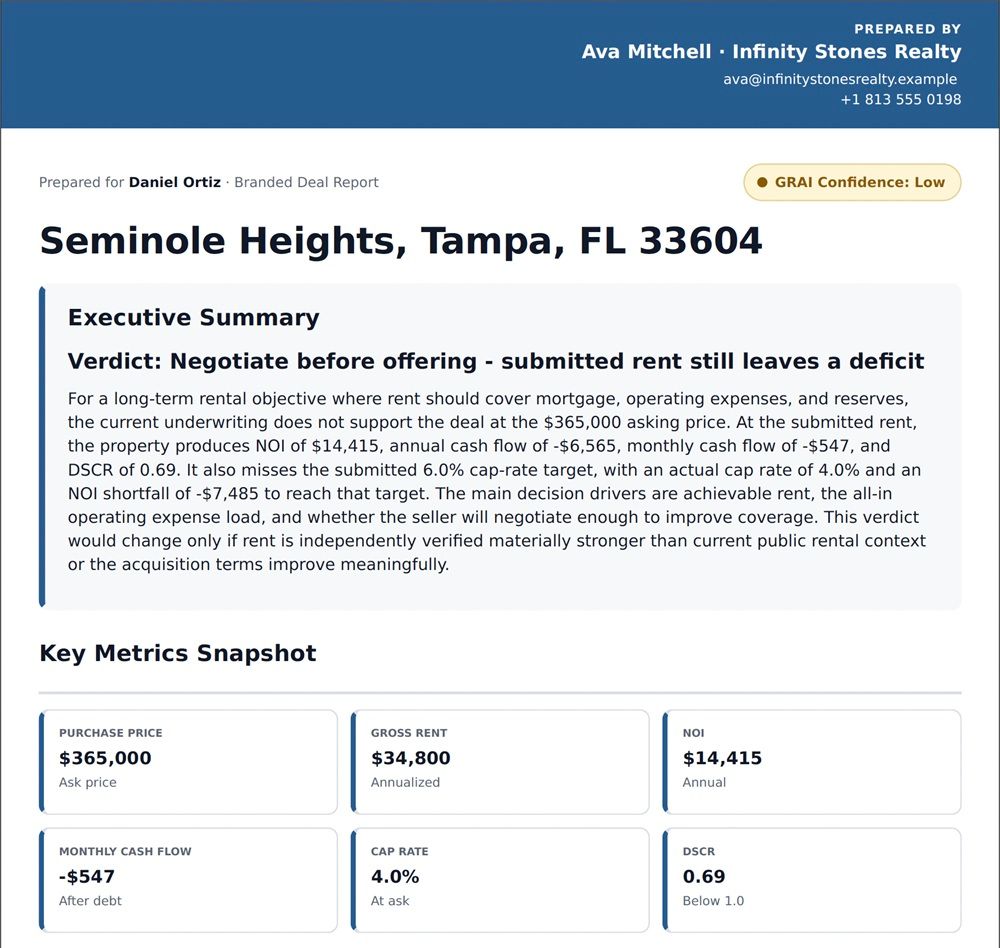
One of GRAI’s sample reports analyzes a Tampa single-family rental in Seminole Heights. The submitted asking price was $365,000, with expected rent of $2,900 per month, or $34,800 annually.
At first glance, a buyer may focus on the gross rent and assume the deal is worth pursuing. The report goes further. Once vacancy, management, insurance, taxes, maintenance reserve, and debt service are included, the report shows annual NOI of $14,415, annual cash flow of -$6,565, monthly cash flow of -$547, a 4.0% cap rate, and DSCR of 0.69. GRAI confidence is marked Low, and the executive verdict is to negotiate before offering, because the submitted rent still leaves a deficit.
This is exactly where the report becomes useful. It does not simply reject the deal and move on. It explains the conditions under which the conversation could change: stronger independently verified rent, better acquisition terms, improved financing, or a different investor objective.
That is the kind of analysis investor clients remember. It shows that the agent is not trying to force every property into a positive story. The agent is helping the client understand what the deal can and cannot support.
Spreadsheets remain powerful. Experienced investors, analysts, and acquisition teams will continue to use them because they are flexible and customizable.
The issue is not whether spreadsheets work. They do. The issue is whether they are the right response to every early-stage investor question. When a client sends multiple properties in a week, spending hours building and formatting custom analysis for each one is rarely practical.
A GRAI Branded Deal Report is not trying to replace every advanced spreadsheet. It is designed to compress the early decision workflow: intake, underwriting, scenario analysis, risk flags, confidence scoring, and client-ready presentation. If the deal becomes serious, deeper custom underwriting may still follow. But the agent does not need to start every conversation from a blank workbook.
Deal calculators are useful because they help investors move faster than manual math. They can calculate cash flow, cap rate, cash-on-cash return, DSCR, purchase assumptions, and financing scenarios. Many investor-facing agents already use these tools, and they can be valuable.
The limitation is that a calculator usually produces metrics. It does not automatically produce a branded decision memo with a verdict, assumptions, risk interpretation, confidence score, diligence checklist, and client talk track.
The difference is not only calculation. It is communication.
A calculator helps the user understand numbers. A branded deal report helps the agent explain a decision.
Generic AI tools such as ChatGPT, Claude, Gemini, and others can be helpful for real estate work. They can summarize documents, explain concepts, draft emails, create checklists, interpret spreadsheets, and help users think through property questions.
The challenge is repeatability and output discipline. A generic AI chat depends heavily on the user’s prompt, the evidence provided, and the structure the user creates manually. It may produce a thoughtful answer, but it does not automatically guide the agent through a deal-specific intake, generate a standardized branded report, label assumptions consistently, produce a confidence score, and format the result as a client-ready PDF.
GRAI Branded Deal Reports are built as a product workflow rather than an open-ended chat. The user does not need to design the analysis structure from scratch. The adaptive intake leads the process, and the output is designed for the client conversation.
That distinction is important. The future of real estate AI is not only chat. It is finished, accountable deliverables that professionals can use.
Some agents and teams already use analysts, transaction coordinators, virtual assistants, or offshore support to prepare property analysis. That can work well for larger teams or high-value clients.
The problem is speed and consistency. Manual support depends on availability, analyst quality, templates, turnaround time, and how clearly the agent explains the deal objective. For time-sensitive investor leads, the delay itself can reduce the value of the analysis.
GRAI Branded Deal Reports give agents a faster first layer. A full-time analyst may still be useful for complex deals, portfolio reviews, or institutional-level underwriting. But for property-level screening and client follow-up, agents can now generate a branded memo while the opportunity is still fresh.
GRAI Branded Deal Reports should be understood as a new layer in the agent workflow. They are not meant to replace portals, MLS access, local knowledge, calculators, spreadsheets, inspectors, appraisers, lenders, attorneys, or tax advisors.
They sit between property discovery and deeper professional diligence.
The agent or client identifies a property. The adaptive intake collects the deal objective and relevant inputs. GRAI produces a branded report that frames the opportunity, numbers, risks, confidence, and next steps. If the report indicates that the deal deserves further attention, the agent can then move toward offer strategy, lender review, inspection, legal review, tax advice, contractor estimates, or deeper underwriting.
That is the right sequence. The report is not the final authority. It is the decision-support layer that helps everyone decide whether the next step is worth taking.
Because the intake adapts to the property type and objective, the exact inputs will differ. A short-term rental, a BRRRR, a commercial income property, a land development opportunity, and a buy-versus-rent decision do not require the same evidence.
Still, users should bring the best available information. That may include the listing URL or property address, asking price or expected acquisition price, the client’s objective, available income or rent assumptions where relevant, financing terms, known expenses, repair or renovation estimates, comps, documents, project details, lease information, zoning or permit context, and any specific question the client wants answered.
For some reports, rent will be central. For others, construction cost, lease rollover, rehab budget, entitlement path, resale strategy, or ownership comparison may matter more. The stronger the input quality, the more useful the report becomes.
When information is missing, the report should not hide that. It should flag the gap and show what needs to be verified.
Ask GRAI to walk you through a full intake for your next rental, BRRRR, or commercial deal in minutes: https://internationalreal.estate/chat
One of the most important parts of a branded deal report is the confidence score.
In real estate, weak evidence can be expensive. A report that sounds certain when the inputs are thin can create false confidence. A report that clearly states low confidence, missing documents, unsupported rent, weak comps, or unverified assumptions is more valuable because it protects the decision.
Confidence scoring helps agents explain uncertainty professionally. It gives them a way to say, “The report is useful, but the evidence does not yet support a strong conclusion.” That is much better than pretending every property can be underwritten with the same level of certainty.
Investor clients do not lose trust because an agent says, “We need to verify this first.” They lose trust when the agent sounds certain and the deal later falls apart.
There are several practical use cases.
An agent can use a report as a response to an investor who sends a listing and asks for an opinion. They can use it before a buyer consultation to show how they analyze deals. They can use it to qualify investor seriousness. They can use it to support a DSCR lender conversation. They can use it to compare two opportunities. They can use it to explain why a deal should be negotiated rather than pursued at asking price. They can use it in a listing pitch to show a seller how investor buyers may evaluate the property.
Over time, these reports become part of the agent’s brand. Every report says something about how the agent works. It shows whether the agent is only chasing a transaction or actually helping the client make a better decision.
The agents who benefit most from this shift will not be the ones who blindly automate everything. They will be the ones who combine local judgment with structured analysis.
AI can prepare the report. The agent still needs to interpret the local context, understand the client’s risk tolerance, know the neighborhood, talk to lenders, verify assumptions, and guide the next step.
That is the future workflow. AI handles the first structured draft of the deal memo. The agent brings judgment, context, relationship, and execution.
For investor-facing agents, this is a major upgrade. It allows them to respond faster, look more professional, and create a repeatable standard for investor conversations.
Real estate AI has often been discussed as chat, search, valuation, or content generation. Branded deal reports point to a different direction: AI as a finished professional deliverable.
This is what makes the category interesting. The output is not just an answer. It is a document an agent can use.
That matters because professional trust is not built only through information. It is built through presentation, clarity, restraint, and repeatability.
A branded deal report can become a lead magnet, a client service tool, a due diligence checklist, a lender handoff, a negotiation aid, and a brand asset. It gives agents a way to make investor conversations more concrete.
The client asks, “Does this deal actually work?”
The agent no longer has to answer with a guess.
Investor clients do not need agents to send more listings. They need agents who can help them judge which listings deserve attention.
That is the purpose of GRAI Branded Deal Reports.
They turn a property opportunity into a structured, branded, client-ready memo with underwriting, scenarios, risk flags, source notes, confidence scoring, and a practical verdict. They work across multiple property types and objectives because the intake adapts to the deal rather than forcing every property through the same template.
This is not about making every property look good.
It is about helping every property get judged properly.
For agents working with investors, that may become the new standard.
You can create a branded real estate deal report with GRAI Branded Deal Reports. The product uses an adaptive intake form to collect property details, deal strategy, assumptions, and supporting information, then generates a branded PDF report with underwriting, scenarios, risk flags, confidence scoring, and a client-ready verdict.
An AI real estate deal report is a structured property analysis generated with AI. It evaluates a property based on the client’s objective and may include underwriting, valuation logic, scenarios, risk flags, assumptions, source notes, confidence scoring, and next diligence steps.
A branded deal report is a property investment memo that carries the agent’s or firm’s branding, including name, logo, and contact details. It allows agents to send investor clients a professional analysis rather than only a listing link or informal opinion.
GRAI uses an adaptive intake form. The user enters the property details, deal type, objective, available assumptions, and supporting information. The intake changes depending on whether the deal is a rental, short-term rental, BRRRR, fix-and-flip, commercial income property, development land, buy-versus-rent decision, or listing pitch. GRAI then generates a branded deal report.
GRAI Branded Deal Reports are priced at a flat $49 per full report, with no subscription. Users can first generate a free property preview before deciding whether to purchase the full report.
GRAI Branded Deal Reports support long-term rentals, mid-term rentals, short-term rentals, BRRRR refinances, fix-and-flip deals, commercial income properties, development land, buy-versus-rent decisions, and listing pitches.
A deal calculator produces metrics. GRAI produces a branded decision memo. The report includes underwriting, scenarios, risk flags, assumptions, confidence scoring, and a client-ready explanation that an agent can use in conversation.
General AI chat tools can help discuss or summarize a property, but they are not purpose-built to generate branded real estate deal reports through an adaptive intake workflow. GRAI is designed specifically for real estate deal analysis, client presentation, confidence scoring, and branded PDF output.
No. GRAI Branded Deal Reports are decision-support documents. They help structure early analysis and diligence, but they do not replace appraisals, inspections, legal advice, tax advice, financing approval, or local professional judgment.
Branded deal reports help agents respond to investor clients with structured analysis rather than informal commentary. They make the agent look more analytical, help clients understand risks, and create a professional deliverable that supports the next conversation.


